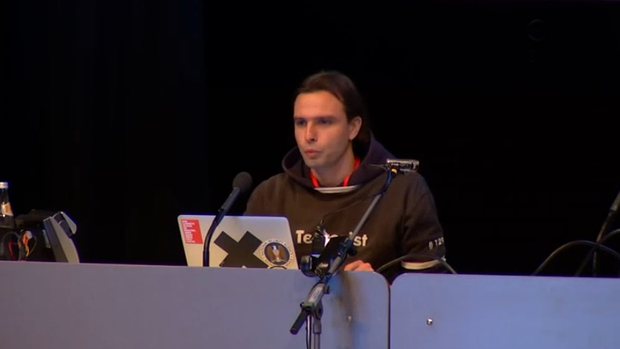
Jan Krissler used high resolution photos, including one from a government press office, to successfully recreate the fingerprints of Germany’s defence minister..
It’s an old cliché of security researchers: fingerprints might appear more secure than passwords. But if your password gets stolen, you can change it to a new one; what happens when your fingerprint gets copied?
That’s no longer an abstract fear: a speaker at the Chaos Communication Congress, an annual meeting of hackers in Germany, demonstrated his method for faking fingerprints using only a few high-definition photographs of his target, German defence minister Ursula von der Leyen.

Jan Krissler, known in hacker circles as Starbug, used commercial software calledVeriFinger and several close-range photos of von der Leyen, including one gleaned from a press release issued by her own office and another he took himself from three meters away, to reverse-engineer the fingerprint.
“After this talk, politicians will presumably wear gloves when talking in public,” he joked.
Also reported at the conference was another security hole seemingly straight out of science-fiction: a so-called “corneal keylogger”. The idea behind the attack is simple. A hacker may have access to a user’s phone camera, but not anything else. How to go from there to stealing all their passwords?
One way, demonstrated on stage, is to read what they’re typing by analysing photographs of the reflections in their eyes. Smartphone cameras, even front-facing ones, are now high-resolution enough that such an attack is possible.
Starbug is no stranger to taking on biometric security. In a high profile stunt in 2013, he spoofed Apple’s TouchID sensors within 24 hours of the release of the iPhone 5S. Using a smudge on the screen of an iPhone, he printed a dummy finger using wood glue and sprayable graphene, which successfully unlocked a phone registered to someone else’s thumb.
For that hack, he had to have physical access to the phone he stole the fingerprint from, in order to get a high resolution scan of the print. His latest demonstration suggests that it may be possible to unlock a phone using a fingerprint stolen without ever touching a person or their property – although actually getting hold of the phone is still needed for the last stage, of actually unlocking it.
The increasing number of successful attacks against biometric identification has led to some security researchers advising that people change the way they think about security measures such as fingerprints and photo ID. Rather than treating them as a replacement for passwords, they should instead be used as a second factor of authentication, or even as something similar to a username: a publicly known piece of information which must be linked to a password before a user can log in.
As the ACLU’s Jay Stanley told the Washington Post, “Biometrics are not secrets… Ideally, they’re unique to each individual, but that’s not the same thing as being a secret.”
And Starbug agrees, telling Zeit in 2013 that “I consider my password safer than my fingerprint… My password is in my head, and if I’m careful when typing, I remain the only one who knows it.”
Jan Krissler I Phone Hacker, Jan Krissler Touch ID hackers,